July 29, 2026
How to Prepare an Apartment for Photography: Light First
What actually matters when preparing an apartment for photography: why an open curtain beats any camera setting, and what to tidy before the shoot.
Most of the difference between apartment photographs that work and ones that do not is settled before the camera comes out of the bag. Preparing an apartment for photography sounds like a question of tidying, but it is mostly a question of light. Half an hour of the right preparation affects the result more than any technical decision made on site.
The eye corrects, the camera does not
Sit in the living room and look around. The room seems evenly lit. You can see the furniture in the dark corner, and you can also see the building across the street through the window.
That is not what is actually happening. The eye adapts locally. It recalibrates every time your gaze moves, and the brain assembles all those glances into one balanced picture. A camera sensor makes a single exposure, for the whole frame, at once.
In an average room the gap between the dark corner and the window is far wider than a sensor can hold in one exposure. Either the window burns out to white, or the corner falls to black. Some of that gap can be bridged in editing, but bridging is a compromise: the wider the gap, the flatter and more artificial the image becomes.
Preparation does one thing. It narrows the gap before anything is photographed. That is why it matters more than any setting on the camera.
Preparing an apartment for photography starts with light
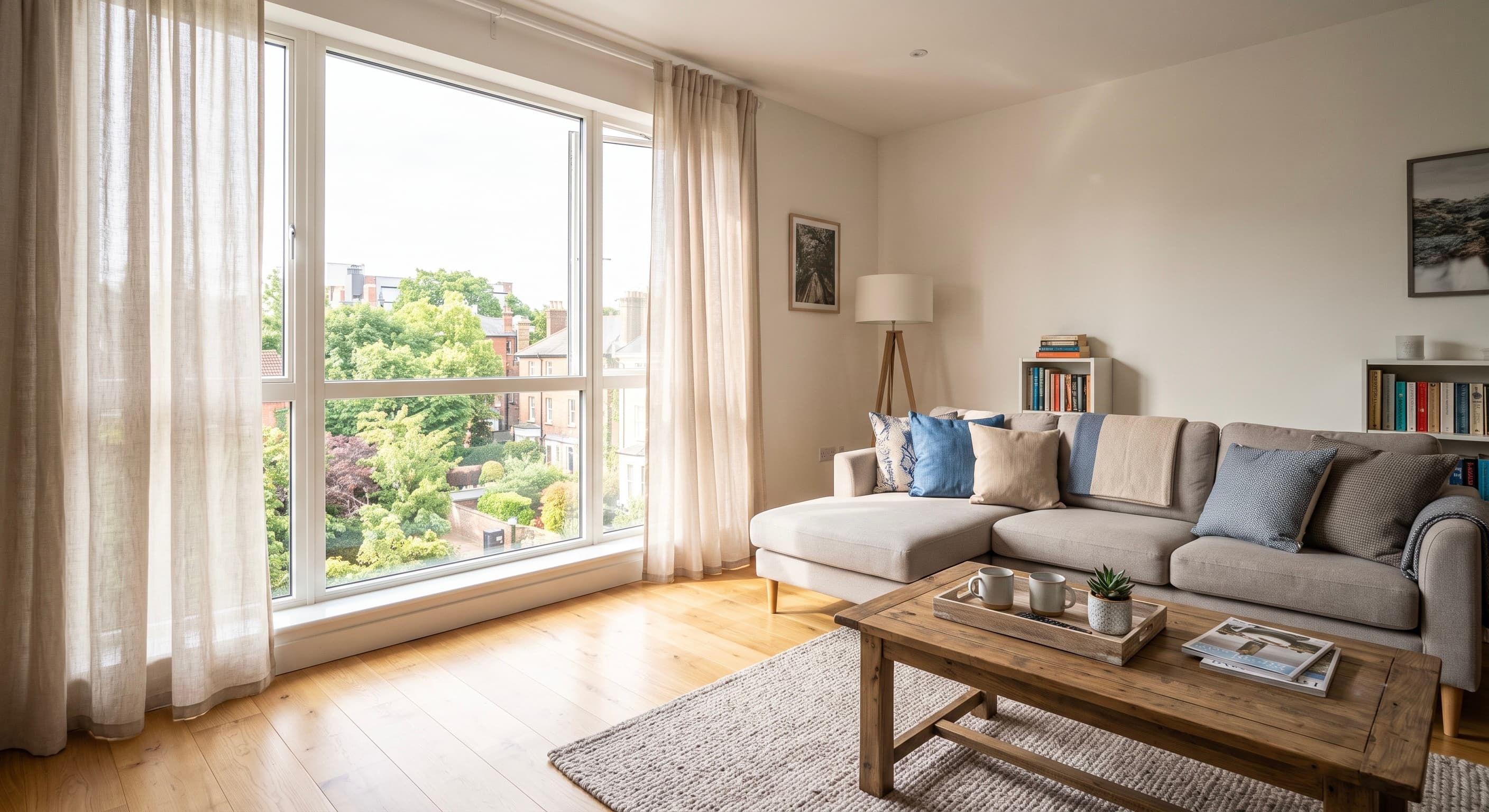
Curtains and blinds open. Partially is fine. A curtain opened a third of the way lets in daylight that fills the shadows at the back of the room and brings the brightness of the room closer to the brightness outside the window. That is the gap, narrowed.
Every light fitting goes on, in the middle of the day too. A lamp in the corner is not there for general brightness, it is there so the corner does not fall to black.
In bathrooms this sometimes reverses. A small bathroom with no window is lit entirely by one fitting, and the colour of that bulb colours the whole room. The eye neutralises the cast within seconds, and you simply see white. The camera sets one white balance for the whole frame, and if that frame holds daylight from the hallway as well as a warm bulb overhead, one of them comes out yellow and the other bluish. So the decision in a bathroom is made on the spot: sometimes the bulb stays on, sometimes it is better switched off. What matters is that the light in the room is consistent, not that it is strong.
This is the smallest item on the list, and the one that changes the most.
There is one more factor that is not inside the apartment at all: the hour. An east-facing facade gets direct sun in the morning, a west-facing one in the afternoon, and a north-facing facade gets almost no direct sun at all. At midday the sun stands above the building, the facade goes flat and the sky burns out. So the first question when scheduling is which way the facade faces, not which day is convenient in the diary.
Tidying: anything out of the frame is a gain
There is an assumption that you can overdo the tidying and make a home look staged. In practice that does not happen. Tidying does not make an apartment sterile, it only removes the things that steal the eye: shoes at the entrance, the bin, a towel on a handle, a charger on the worktop, cleaning products around the sink.
Two things are especially worth the time: bedding pulled straight, and cushions ordered on the sofa. These are the two largest surfaces in the frame, and creased bedding looks worse in a photograph than it does to the eye.
Beyond that: screens off, cables hidden as far as possible, and if the exterior is being photographed too, cars moved away from the entrance.
Anything that leaves the frame before the shoot is something the composition does not have to work around, and it is also what shortens the time spent in the property.
Why it is better with nobody in the apartment
This is the request that sounds strangest, so here is the reasoning. It is best if nobody is in the apartment while the photography is happening.
This is not about comfort. A large part of interior work is shot from the corner of a room, to show the volume of the space rather than a flat wall, and in a small room there is simply nowhere to stand outside the frame. Interiors are often photographed on a tripod with a long exposure, and movement in the room during the exposure ends up in the picture. And when a room has to be revisited to move one detail, it is quicker when the room is empty.
The one person who should be at the property is someone with keys, who knows where the switches are and what may be opened.
The bottom line
If there are twenty minutes before the photographer arrives: open the curtains, switch the lights on, take out of the frame anything that does not belong in it, and step out of the apartment.
And if none of it got done, that is fine. I sort it myself, it is part of the job. Preparation is not a condition for good photography, it only makes the shoot shorter and the result better. A short preparation list, matched to the property, is sent before every shoot, and the Services page sets out what each type of shoot includes.